
Category Archives: Early Childhood Music

Considering Resuming Childrens In-Person Music Classes?

March 20th marked the first day of Spring, as the sun officially crossed the equator. Figuratively, this has been a long winter for most of us. But with Covid vaccinations accelerating and the CDC releasing new guidelines for operating schools, there are more and more options for children’s music teachers to resume in-person classes. But, some music studio owners may not have the room to safely resume classes within CDC guidelines. However, with warmer weather approaching, there are some alternative places to consider for resuming classes which can also offer a good environment for teaching music:

Virtual Children’s Music Classes

It’s important to first mention that online classes are still an option. Many teachers have been successfully conducting virtual music classes throughout the pandemic, although it comes with its challenges. Although most teachers will agree this is not an ideal environment, some parents and studio owners will decide that they would prefer to wait a bit longer to return to the classroom.

Teach Children Music Outdoors

With warmer, sunnier days ahead, children’s music studio owners may choose to resume in-person classes outdoors as an alternative. As we know, nature teaches us about music in many ways, and in turn, music helps connect children with nature. Nature has inspired many great artist and composers over the years, and Spring is especially vigorous with new life and an orchestra for the senses. However, finding an outdoor space with enough room and quiet can be the tricky part. Here are some ideas for outdoor venues for conducting safe in-person music classes for children.

  • Parks and/or Public Spaces – Public parks and spaces are designed to accommodate many people while providing open space to all. Whether it’s a center city park that has a green lawn, or a covered picnic area in a municipal park, the open air and distance these provide can present a good opportunity for a fun and exciting return to music class. While most will allow, its always a good idea to check your local parks and recreation department to see if any permits are required.
  • Churches or Community Centers – Many local churches will have covered areas for outdoor worship, and are happy to grant permission to conduct a music class. You may even find an opportunity to offer faith-based children’s music classes to their congregation. While community centers are often operated by the same municipality as parks, some have independent management that administers schedules for picnic areas and other spaces. You can usually find out online, or by asking someone who is working at the facility.
  • Backyards – Some studios owners may have their own beautiful backyard space with plenty of room to conduct classes outdoors. Teachers also may consider reaching out to parents to see who would be willing to offer their yards or natural space. Or, it might be fun to rotate classes between different backyards, offering a new environment to explore for each class.

Teaching a Hybrid Children’s Music Class

One challenge for studio owners is that while they may have decided to once again conduct in-person classes, some parents who are engaged with online music classes will remain uncomfortable with the idea. There are many educators who are currently conducting in-person classes along with an online option, which poses its own set of challenges. It’s hard to provide the best advice on whether to offer this option or not, so communicating well with parents is key to understanding what is suitable in a specific situation.

As society continues to incrementally loosen its restrictions and Spring brings more opportunities for warm weather and outdoor music instruction, children’s music education teachers and studio owners have greater options for how to resume to in-person classes for their students. Working within recommended guidelines and close communication with parents is important to ensuring a smooth and safe transition back into the classroom.
The Pathway to Music Literacy in Children

From whatever country they were born, or environment they were born into, all children are born with a natural ability and inclination to sing and dance. Famed children’s music researcher, teacher, author and lecturer Dr. Edwin E. Gordon concluded that until age 9, children are in the developmental stage of their music aptitude and disposition. Throughout this time, parents and teachers have a great impact on how musical a child will be for life.

In this series on the Pathway to Music Literacy, we have explored the various foundations and methodology that make children’s music curriculum successful, touching last on the connection between music and movement. In this final installment, we’ll sum up how nurturing all these basic music skills prepares children for a pathway to independent musicianship and enduring music-making capabilities.

Aural Preparation is Key to Music Development

Just as language begins in children with aural preparation, music also starts as an aural reality for the child. Only after this reality exists is the child able to then read and write language, or understand the written form of music in notation. Just as words are the building blocks of language, tonal and rhythm patterns comprise the vocabulary of musical language. Once children become familiar with these patterns, they love playing aural games that apply both a neutral, chanted syllable, or in the context of a familiar song.

Children singing melodic patterns in a Musikgarten class.

Teaching Children to Write and Read Music

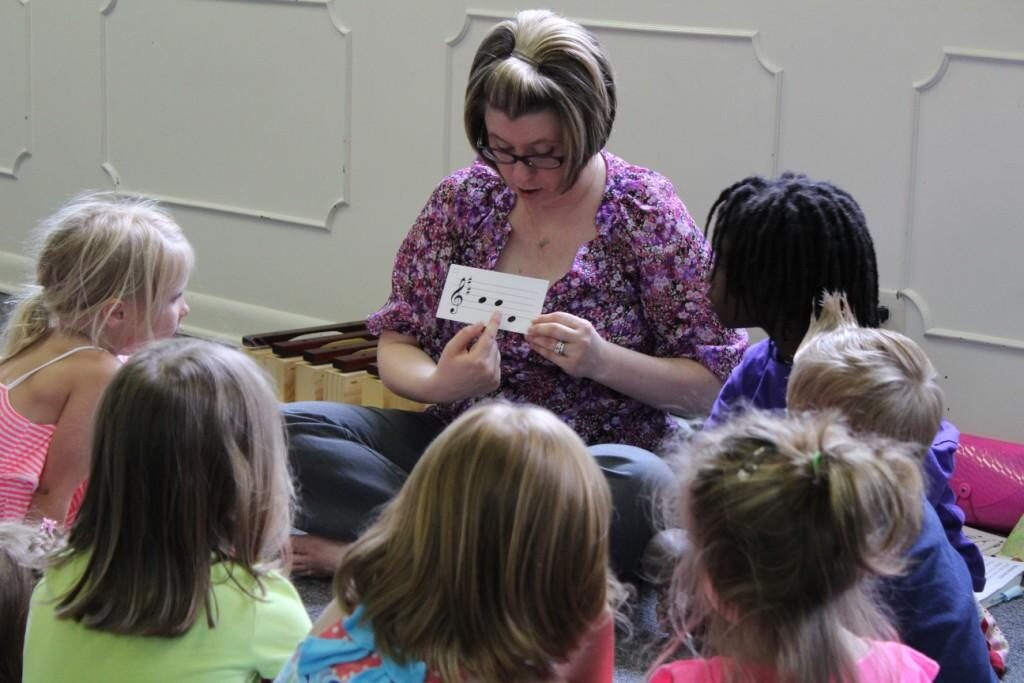
Once children are able to understand and play aural games, they are ready to see those familiar patterns in symbols. Active, participatory notation games show these symbols to the children on a sensory motor level. With repetition comes understanding, and as they begin to be able to discriminate between several familiar patterns, they can be further challenged to find the same patterns in unfamiliar songs. Instead of simply decoding, they are actually reading with comprehension. Notation games of listening and responding to a series of patterns also teach children to take dictation and write out songs they know so well.

Assessing the Pathway to Music for Children

In early childhood music education, accurate assessment is crucial in knowing how to lead children on their pathway to music literacy. Through a series of steps, music teachers can determine specific pre-requisites to determine a child’s readiness. Once those steps have been mastered, children will be able to look at an unfamiliar piece of music and do the following:

  • Identify the familiar patterns within the song
  • By making inferences, they will figure out the unfamiliar patterns
  • Hear the music in their heads

This approach prompts children to begin to think in the language of music, and play it on the keyboard.

Instilling Music Improvisation and Composition in Children

As children learn to manipulate words, phrases, speak, and write complete sentences, they gain a better understanding and eventually become conversant. The same is true in the pathway to music literacy. By first understanding rhythmic and tonal patterns, recognizing these in the form of notation symbols, and then learning to write these patterns, children obtain the ability to start to manipulate and improvise. Once they begin to improvise patterns, they can begin to improvise phrases and eventually parts of a composition.

Through this improvisation, children become musically fluent and can contribute a musical

thought in the appropriate tonality, meter, and style. It is when they gain this intuition of musical patterns that children can truly improvise and compose through Music Literacy.

Much of the content for this post was based on the introduction to Music Makers: at The Keyboard, childhood music curriculum developed by Musikgarten.

Interested in knowing more about Musikgarten’s Music Makers: at the Keyboard material? Click this link to attend a Free information session.

The Listening and Movement Connection

Our series on how early childhood music programs influence Music Literacy at the Keyboard continues with the importance of body movement with music and listening. We have explored how singing a repertoire of familiar songs, as well as setting a good foundation of keyboard posture, are vital to instrumental education. Now the close relationship between music and movement complements these footings toward success in music literacy.

The Connection Between Music and Movement

Cultures all across the globe have used movement as the body’s expression of rhythm, which shapes the way we use and understand language. Children naturally desire and enjoy movement because it is exhilarating and energizing. A good foundation of understanding body manipulation helps them to play an instrument expressively.

Listening is vital to nearly all learning, not the least music education. And just as controlling body movement is more challenging for children today, so is learning to listen well. Developing a “listening ear” must compete with the increased amount of noise/sound and visual stimulation in a child’s environment.

Listening and movement are closely aligned through the ears two major functions. The first is vestibular, which controls balance, and thus nearly all movement. The second is the auditory, which directs hearing and voluntary listening. Therefore, it is vital to establish the important link between those two functions in early childhood music education.

Music and movement during a Musikgarten group music class.

How Movement Benefits Early Childhood Music Education

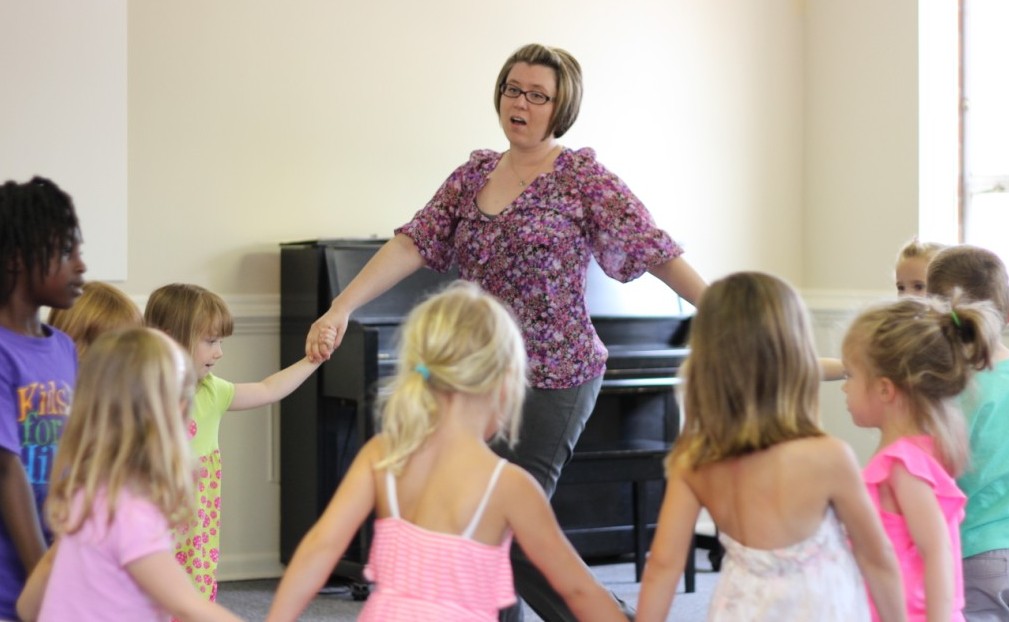
Rhythm and beat competency are emphasized in movement activities in early childhood music classes, particularly through tapping and drumming. Clapping, tapping one’s body, or using instruments such as rattles, sticks, bells or drums while singing helps to develop a child’s rhythm and beat. These, along with other group activities such as passing a beanbag in a song circle, brings children joy and social fulfillment. Drumming, in particular, has been a unique attraction for young and old alike in cultures all across the world. The tactile use of hands provides muscular memory while reinforcing the idea that the sound produced is directly related to the quality of the touch.

Dancing to recorded music as a group also provides a good opportunity for children to experience the flow of music while connecting to the larger community of their peers and teachers. In the most successful children’s music curriculum, teachers repeat these movement activities early and often so that the child in time feels free to express themselves through movement.

Early Listening Skills Make Children Better Musicians

Listening is defined as giving attention with the ear with the purpose of hearing. With the constant assault of noise and sound in our environment today, active listening is extremely important in order for children to concentrate. The very best training for listening employs the use of singing, chanting, and body movement to make the aforementioned connection between the auditory and balance/movement functions in the ear. Therefore, children’s music curriculum and teachers will continually engage in listening activities such as singing, reciting, and listening to music. The music teacher also instructs children to develop a listening posture that allows them to hear the music in their heads. This is particularly helpful at the piano, where body posture and hand position and technique are important for learning the keyboard. Through modeling and encouragement, the successful teacher is demonstrating attentive listening both through movement and posture.

Establishing and reinforcing the important connection between movement and listening helps prepare young children for playing any instrument. The union they feel between singing, drumming, and dancing will support the transfer of their understanding to piano. By introducing the keyboard as an extension of the body in this way, children learn to play the instrument musically – feeling the total experience of the instrument.

In our final installment of this series about Music Literacy at the Keyboard, we will see how all of these different foundational music teaching tools set children on the deliberate Pathway to Literacy

Much of the content for this post was based on the introduction to Music Makers: at the Keyboard, childhood music curriculum developed by Musikgarten.

Interested in knowing more about Musikgarten’s Music Makers: at the Keyboard material? Click this link to attend a Free information session.

Music Literacy and the Second Stage of Child Development

Merriam-Webster first defines literacy as simply “the ability to read and write,” but a second definition expands that to “knowledge that relates to a specified subject.” This is an important distinction, especially when considering childhood music literacy. In our next series of articles, we will explore how music literacy applies to the second stage of child development, specifically in playing the piano and instrument instruction. While most children’s music programs focus on music and movement in the first stages of development, many fall short of continuing the progress in the second stage of child development necessary to achieve music literacy.  

The Second Stage of Childhood Development

Developmental biologist Jean Piaget established the theory of phases of normal intellectual development from infancy through childhood. The second stage, which Paiget terms Concrete Operational, is where children’s thinking becomes less on themselves and more on their awareness of external events. Some experts argue that development is actually continuous, but Piaget did agree that the depending on the child, the age ranges could vary slightly. While Piaget defines the second stage of childhood development being from ages 7 to 11 years, our focus in this series of articles will focus on the 6 to 9-year-old child.

Ready to Face and Decipher New Challenges

From ages 6 to 9 years, the child has begun a new phase of development both physically and cognitively. They are eager to face fresh challenges and have a growing aptitude for the refined movement needed to play an instrument. Their sensory motor functions have been well-integrated over the last six years, and serve as a good foundation for abstract learning. They are starting to not be satisfied merely with knowing the name of an object, but having the desire to know the how and why of things. One result is that the child’s mind is now interested in symbols, patterns, and codes to explore. This in turn helps to develop an appetite for improvisation and cooperative learning with other children.

Children Love to be Part of a Group 

Beginning in the second stage of development, and sometimes earlier, children are self-aware and ready to become part of a group, especially with peers. A peer group setting becomes a place where the child can begin to learn rules, push limits, and test ideas. This important stage of identity has the benefit of teaching important social skills of how to work with others in teams.

Groups are considered very useful for learning things, as questions can be asked and addressed from different perspectives. This is why nearly all children’s education programs use group activities in the learning process. This is no different for childhood music programs. Children love being with and making music with others. The desire to contribute to the group requires deep concentration and absorption while teaching valuable lessons in cooperative learning.

Music Literacy through Children’s Group Keyboard Lessons

Learning the keyboard provides children with the cognitive challenges and group dynamic that they desire. Music literacy applied to piano playing is much more than reading and recognizing notation or finding the correct keys, but also gives meaning to those notes in a way that allows for composition and improvisation. It is a child’s desire to communicate that motivates them to further develop a deep relationship with the aural and written art of music. This aural approach to music literacy becomes the foundation which provides the child a delightful transition to the world of music notation and understanding. This aural-to-visual method of literacy allows children to understand and appreciate music in terms of its tonality, meter, and style, while further refining their ability to listen.

In our next installments, we will explore specifically how discovering the keyboard in a group setting can be very different from the mechanical drills and rote learning that traditional piano learning imposed.    

Much of the content for this post was based on the introduction to Music Makers: at the Keyboard, childhood music curriculum developed by Musikgarten.

Interested in knowing more about Musikgarten’s Music Makers: at the Keyboard material? Click this link to attend a Free information session.

Small Business Tips for Emerging from an Economic Downturn

With the recent approval of two Covid-19 vaccinations, and a second economic relief package from Congress, small businesses such as Children’s Music Studios can begin to share the hope that the economy will start to pick back up in 2021. Many small business owners have not fared well during the crisis. Some 30% to 40% of those most affected by social distancing have gone inactive since February.  Typically this time of year, small business owners are setting goals and making plans for growth in the coming year. The need to plan and adjust is just as important now as ever, but the approach and mental process is different in a flagging economy.

Tips for rebuilding your small business after Covid-19

  • Understand your prospective customers perception – Consumers are extremely cautious coming out of an economic upheaval. If they believe money is going to be tight (even if they have it), they are going to behave as such. Your message to them should be that your services are very important and a good value. It is also a good time to focus on keeping quality and customer satisfaction high.
  •  Take a hard look at your finances – It’s important to monitor your cash flow very carefully and forecast it at least three months in advance. Separate the essential expenditures from those that can wait, and work with creditors to spread or reduce payments while you get back on your feet. If your cash flow projection means that you will need to borrow in order to stay afloat, identify financial resources to help you recover.
  • Put together a marketing plan – You will not be able to market the exact same way as our economy comes limping out of the pandemic. Start by letting people know that you are back to business and offer them something of value to show you are in this together. We have previously explored how to make the best use of existing marketing resources with little additional cost. However, while many companies cut back on marketing in an economic downturn, savvy business owners understand it can be a good opportunity to capture market share with smart investment.
  • Develop a time line and contingency plan – When resources are scarce, a time line can help you to understand what actions (and expenses) should be addressed first. Rebuilding a business is just that – a step-by-step building process with contingencies. Knowing how and when to address priorities helps to balance resources.  Finally, be better prepared for the next time an unexpected downturn happens – and it will. Take what you have learned from this experience and prepare a well thought out plan for a better reaction to loss in customers and revenue.

While it is unfortunate that many small businesses across the world will never be able to open their doors again due to this pandemic, studio owners of children’s music programs can begin to make concrete plans on how to recover stronger than ever. And when the next downturn happens, that valuable experience will make them better prepared to endure it.  

Musikgarten is the leader in early childhood music education — for children and teachers, that offers a complete multi-year educational program that helps infants, toddlers, and children develop a deep love of music and the ability to express it. For more about Musikgarten and its offerings, go to https://www.musikgarten.org/.

Nurturing Customer Relationships with Music Students and Parents

While we are by no means out of the woods of this pandemic, the recent vaccine news gives us all some hope that there is light at the end of the tunnel. Predictions for when we can safely resume normal activities vary from early Summer to the end of 2021. Depending on the state in which their children’s music studio resides, and personal preference, early childhood music program teachers will have a degree of flexibility as to when they can begin to offer in-person learning. For many educators, this time after a long and painful separation from beloved students cannot come too soon. With this anticipation in mind, studio owners and teachers can be marketing to return with a large number of enthusiastic students and parents.

Preparing to Return to In-person Children’s Music Classes

Many owners and teachers of children’s music studios have been offering online classes for students and parents during the pandemic, but most all agree that in-person teaching is preferable. So, in order to transition to a robust return to an in-person classroom setting, here are some marketing tips to consider.

  • Existing and Past Customers – the Low Hanging Fruit Most of us have heard the marketing adage that it costs five times as much to gain a new customer than to keep an existing one. Focusing efforts on Customer Relationship Management (CRM) rather than new customer acquisition begins with developing and managing your Customer Relationship Database (CRD). A CRD is basically a customer contact list with other customer characteristics. Business owners can start compiling a database by dusting off old customer records and creating a single list of customer contacts with whatever information you may have, whether its mailing address, phone number, email, or a combination of those. Spreadsheets are very handy for this, and can also include children’s names, their age and level of music education, etc. Please keep in mind that this kind of information is very sensitive, so it’s important to take precautions to safeguard access to the list.
  • Categorize Your Contact List – Some music studio owners may haveyears of contact records witha mixed bag of phone numbers, addresses, and or/emails. You will want to separate your CRD in as many like groups as possible. Contact method is a good way to start because it often dictates how you will contact your customers in marketing campaigns. Start with emails first, because it is still one of the most cost-effective way to reach customers. Depending on how you decide to use phone numbers, group texting can be very cost-effective (but be sure to set it up without all reply), but does not work on older landlines. Addresses for mailing programs would be the least cost-effective method of contact because of postage costs. You may also want to then categorize your customers by former and current, past purchases, or music program level. Keep in mind that just because someone has not been in the program for five years does not mean they are not a valuable contact.
  • Plan and Execute – A robust and well-organized Customer Relationship Database does no good if it is not utilized. Once your list is compiled and organized, put together a plan on how you will execute your marketing efforts. How many categories do you have with each contact method? For example, emails for current customers vs. emails for past customers.  Marketing messages and “calls to action” for each category will vary, with current customer emails encouraging new class sign-ups, while past customer emails may ask for a referral or testimonial. Determine your goals for each category, and what steps you must take to reach them. There are many free and paid Customer Relationship software programs that can help with emailing, texting, and even traditional mailing programs.
  • Messaging the Message – Before pulling the trigger on an email, text, calling, or mailing marketing campaign, you will want to make sure your messaging is clear while matching your various targeted categories. For example, you will not want to ask a past customer whose children are now grown about music classes for their grown children, but you may ask them if they know parents who might benefit from your services. For getting back to in-person classes, write your message as to create anticipation for the upcoming classes. Lastly, be sure to ask recipients to take action in your message, whether it is signing up for a class, going to your web site, or forwarding an email to a friend or family member who might be interested. The bottom line is to create a message for each category of contacts that is meaningful for that specific group.

While cases are still rising, the eventual end of the Covid-19 pandemic is finally coming into sight. In preparation and anticipation for that, now is a good time for children’s music studio owners to gather and organize their customer contact information into a Customer Relationship Database. With this CRD, there should then be a solid plan on how marketing campaigns will be executed, so when the time comes, you are ready.

Musikgarten is the leader in early childhood music education — for children and teachers, that offers a complete multi-year educational program that helps infants, toddlers, and children develop a deep love of music and the ability to express it. For more about Musikgarten and its offerings, go to https://www.musikgarten.org/.

The Importance of Teaching Children to be Thankful

Thanksgiving is the perfect time to teach children the importance of being grateful. It’s not uncommon for children, let alone adults, to disregard the significance of the little things that go on in our daily lives. While holidays do stand out in the memories of children, they don’t often understand the reason that family and friends are getting together and sharing meals. Even this year, when the COVID pandemic puts limits on our Thanksgiving gatherings, caregivers should think about ways to teach children how to appreciate things present in their lives as well as significant events and others in the past.

Expressing gratitude can decrease stress and increase a feeling of belonging. There are many ways that parents and caregivers can model behavior and teach children to be thankful.

Ways to Teach Children Gratitude 

  • Model Thanks Every Day – Teaching gratitude starts with the role-models in children’s everyday lives, whether a parent, a sibling, or a music teacher. Saying thank you to others when they assist you, no matter how small the gesture, sets an impression that children will mimic.
  • Discuss your meaning of Thanksgiving – The historic accuracy of the original “Thanksgiving Story” has been the subject of much debate over the years, and parents can decide whether to speak about it with their children.  It is important to talk about what thanksgiving means for your family so that they may put into context what you are truly thankful for, while giving them a chance to talk about things that they love.
  • Talk About Where Food Comes From – For most of us, food is something for which we depend on others. A study found that 25% of primary school children did not know where butter or cheese came from. Talk with your children about where and how food is produced, and how grateful you are for having such easy access to food.
  • Show the Joy of Giving – As you talk to your child about being grateful for what you have, it’s a good time to talk also about those who may not be as fortunate. Giving back, whether it is participating in a local food drive or donating to a worthy cause, children better understand the value of what they should be thankful for, while also observing empathy.
  • Create New Memories for Thankfulness – Create situations and activities for your family to spend time together without the typical outside influences of screens and other distractions. The act of preparing the Thanksgiving meal can be a great opportunity for the family to work together and talk about gratitude.
  • Ritual, Ceremony, and Tradition – We have written about how children love ritual, ceremony, and consistency. Even before science, all of the major religions understood the importance of gratitude. Whether your gathering gives blessing or talks about gratitude over the Thanksgiving meal, it can become a teaching tradition that children will learn from and cherish.
  • Be Sincere About Being Thankful – Young children, even before they understand language, are picking up on facial expressions and gestures from their role models. Sincerity is not often thought of as a physical act, but children can pick up on when adults give their undivided attention to a gesture, make eye contact, and smile after thanks is given.

Studies have found that people who practice gratitude gain many benefits in both physical and psychological health. From a teaching perspective, kids who understand gratitude have better grades and are less likely to get depressed. So whether at home around the Thanksgiving table, or in a classroom setting such as a children’s music class, learning to show gratitude is important and beneficial to the long term health of the child.

The Role of Adults in Young Children’s Music Class

Exploring the natural development phases of The Nature of the Young Child, we have shown how the first phases of life are crucial in how a child discovers independence. Our final part of this series explores the child’s home environment, and in particular, the role of adults in influencing the physical and psychological well-being of children. This is not merely limited to the role of parents, but also other caregivers and influential adults such as teachers of children’s music programs.

When we refer to environment in how it influences the development of the young child, we are not just referring to people, but include also the places and objects surrounding the child. However, the role of the parent or caregiver is an important model for the child. As children are introduced to new environments, they look to the guidance of their familiar people for a comfort level that allows them to explore new interactions. This is why parent/caregiver participation is so important in an early childhood music class. These may be one of the first classroom experiences of the child’s life, and the attitude the caregiver shares in the experience will influence the child’s attitude toward education and participation with others.

Suggestions for Adults in Young Children’s Music Classes

  • Take Time to Listen to Toddlers – While their language may not be fully developed, modeling respect for what they have to say will show them that it should be done for others.
  • Acknowledge and Respect – Recognize a child’s individuality and efforts that are being made in a respectful manner.
  • Speak Clearly and in Full Sentences – Baby talk is not helpful for language development, so use complete sentences and enunciate clearly to help them develop expressive ideas of their experiences.
  • Encourage  Them to Participate, Then Let Them Make the Choice – Offer an activity and acknowledge the child, but if they do not respond, move on and let them feel free to sit and observe.
  • Be Courteous in Modeling – Children between the ages of 2.5 and 4 love learning the precise movements of adults, so model courtesy when greeting others, handling instruments, putting things away, and saying goodbye.
  • Keep Things Orderly and Clean  Keeping a musical environment clean, whether in the classroom or at home, makes a lasting impression.
  • Be Melodious in Movement and Sound – Being graceful and singing in a calming, pleasant demeanor enriches the musical experience for the child.
  • Children Love Ritual, Ceremony, and Consistency – Children need a predictable and comfortable structure from which to explore and experiment, but it’s important to relinquish control without abandoning the child during class.

Perhaps the most endearing quality of children is their never-ending sense of wonder and amazement. By observing and engaging the child while allowing them to discover things on their own, adults energize their curiosity and sensorimotor mode. In these moments of deep concentration and reflection is where we observe and nurture their wonder-filled discoveries and creativity.

Much of the content for this post was based on the introduction to Family Music for Babies and Family Music for Toddlers, an early childhood music curriculum developed by Musikgarten.

The Role of Music in Early Childhood Development

In this third installment of our series on The Nature of the Young Child, we continue to explore how children learn during the first phases of life, and how the first three years in particular are critical. Based on the pedagogical philosophy of acclaimed educator Maria  Montessori to “follow the child,” there are several experiences that influence sensory and motor development for neurological organization. Caregivers and children’s music teachers can see how music has a role to play in this vital stage of childhood development.

Children Learn Through Movement

Once they have learned to walk, toddlers spend much of their time exploring the world around them. Any parent can tell you that they are constantly on the move, learning to obtain control of their body movements. As a prerequisite to cognitive learning, sensorimotor integration is one of the earliest ways that babies and toddlers learn about their world.  From reaching and grasping to crawling and walking, children are explorers by nature. Through repetition and practice, the toddler begins to unconsciously strengthen body to mind neural connections. Kinesthetic awareness, an inner sense that operates below the conscious level, contributes information about how the body feels as it moves. Such awareness is invaluable to all learning, including music – through movements such as clapping, tapping, bouncing, or dancing.

Listening is the Most Important Sensory Channel for Learning

Formed in utero, the ear is functional at four months after conception, allowing the fetus to begin hearing their mother’s breathing, heartbeat, digestion, talking, and singing. The ear is an organ that never rests, and listening is important to almost all aspects of learning – physical, social, emotional, and intellectual. Music helps children to focus their attention on familiar sounds, whether it is a lullaby sung by a parent or a children’s music class, and helps to teach appropriate interaction with adults and peers.

Shaping Language is the Child’s Great Work

 At the earliest stages of life, children understand that speaking is what constitutes communication in their world. Sounds that come from the mouth such as cooing are very fascinating to babies, eliciting excited responses that begin a back and forth form of communication. In the beginning, tone and inflection are even more important than the words themselves, and infants will imitate and practice sounds as they become excited about their own vocalizations. Music offers a very strong source of pleasure for children, as it soothes, elicits attention, and stimulates response. The rhythm, repetition, and rhyming of music all contribute to a child’s language development as they are allowed to sing to themselves, make up words, and silly noises.

Children Have a Natural Tendency for Order 

As children experience the massive amount of information coming through their senses, they begin to sort, order, classify and categorize. Remarkable because it is not based on any previous experience, this process helps children to understand their environment and how to put persons and things in their accustomed place.  Maria Montessori understood this, and once order is established around the age of 3.5 years, change is better tolerated in the external environment. Music participation and education also helps establish a sense of order through repetition and routine of familiar songs and movements.

Independence and Initiative are the Embodiment of Learning

As children develop through movement and language, they are also beginning to move from total dependence on their caregiver towards a growing sense of self. Parents fully understand the “strong will” of a toddler, and at around 2 years of age, they love to participate in self-chosen tasks. Insisting on completing tasks alone, toddlers are showing a desire to free themselves from dependency. Music can provide a valuable tool for children to explore their independence. For example, playing different developmentally appropriate instruments presents cause and effect as they see what sounds they can make with them.

Repetition is Essential to Learning 

Children love to repeat enjoyable experiences, and this is an important aspect of both learning and teaching. While allowing them to enjoy the experience over and over, the repeated action boosts both cognitive as well as muscle memory. Often with deep concentration, children repeat tasks of their own choosing until they have mastered it and established control. It is then that they look for other ways to put the actions to work. Music is a wonderful tool for providing children with both a repetitive learning task, but also a means by which to take those tasks and add their own creativity.

In the first years of life, children use these mechanisms to understand their world and grow to free themselves of total dependence on others. Music, along with movement, can provide caregivers and early childhood music teachers with powerful tools to assist in this crucial stage of child development. In our next blog, we will explore the role of adults in the child’s environment, and how to encourage these mechanisms for both the physical and psychological well-being of the child.  

 Much of the content for this post was based on the introduction to Family Music for Babies and Family Music for Toddlers, an early childhood music curriculum developed by Musikgarten.

An Open Letter to Musikgarten Teachers

Down the river, O, down the river, O, down the river we go….

down the river, O, down the river, O,  down the Ohio….

When everything started to change this past March, I was teaching several children whose parents had paid for a full 45-week year of lessons. Like many teachers, I moved everything online, thinking it would be temporary. I recall setting up seven weeks of Zoom meetings for each class and every private student, and laughing with a co-worker that seven would be more than we would need.

The river is up and the channel is deep….

I was up for the challenge, operating in a sort of “emergency mode”, happy to apply what I knew about teaching online to my own studio, assuming it would be for a short time. The first few weeks were full of successes, and I participated in worldwide music education forums to address online teaching strategies and best practices during a pandemic. I was going full steam, with little let-down.

…the wind is steady and strong….

In May, we reached the end of the school year, and I noticed many of my colleagues “calling it a day” on their online teaching. Easy for them to say, I thought, but my families go until August 1! I kept moving forward- adapting, learning, changing my approach, talking to parents and making every connection I could online with the children. Parents were tired, children were at one moment frenzied, the next, glazed.

…O, won’t we have a jolly good time, as we go sailing along?

I shifted some of my thinking to create order and purpose for parents and their children. I held an online Parent Orientation. I trusted the Musikgarten curriculum, and kept purposefully applying the tried-and-true philosophies of music learning. And soon, the children started simply amazing me. They learned, they listened, they sang, and they danced! We laughed, improvised, and played games. Parents began smiling more, dancing more, participating more.  

After a particularly engaging and enjoyable class, I went for a walk, on a bit of a “high” from the joyful music-making that had just taken place in our Cycle of Seasons class. Suddenly, I realized that I don’t actually have a choice- I must keep teaching, even if it’s online for now. Why? Because the children don’t have a “Pause” button. Children are going to keep growing. Like the water in Down the River, the current continues to flow! I have to set aside my frustrations, my desires, my dislike of the “screen”, and my longings for in-person teaching, because …the children can’t wait. They can’t just “pause” and pick it up later. The current is flowing, and I don’t want to miss any of it, or rob them of the nurturing gift of music at this time or any time.

I reflected on all that happens in a normal Musikgarten class in just 8 to 10 weeks. As the passionate Musikgarten teacher that you are, I invite you to do the same. Think of the strides the children make in that time, all while they are developing and growing in every way. We always are aware that we teach the whole child- so picture the children going 8 to 10 weeks without the influence of music and movement. That is a dismal picture! We really cannot afford to short-change them. They need us.

It’s not about me as a teacher; it’s about what I can bring to these students as they continue to grow and develop. Sure, they may be able to physically wait for in-person, but at what cost? Developmentally, there is no waiting. They are growing – with us or without us. Let’s be with them to bring to them what they need as they sail along in their ever flowing and deep current.

Contributed by Amy Rucker: Musikgarten Teacher Trainer, teacher, and past President for the Early Childhood Music and Movement Association (ECMMA)